Subcutaneous Injection Technique: A Researcher's Reference
Clean subcutaneous injection technique decides whether a peptide protocol stays reproducible or gets confounded by infection, erratic absorption, and tissue damage. This reference covers site selection and rotation, needle gauge and length, the pinch-or-no-pinch decision, and sharps disposal.
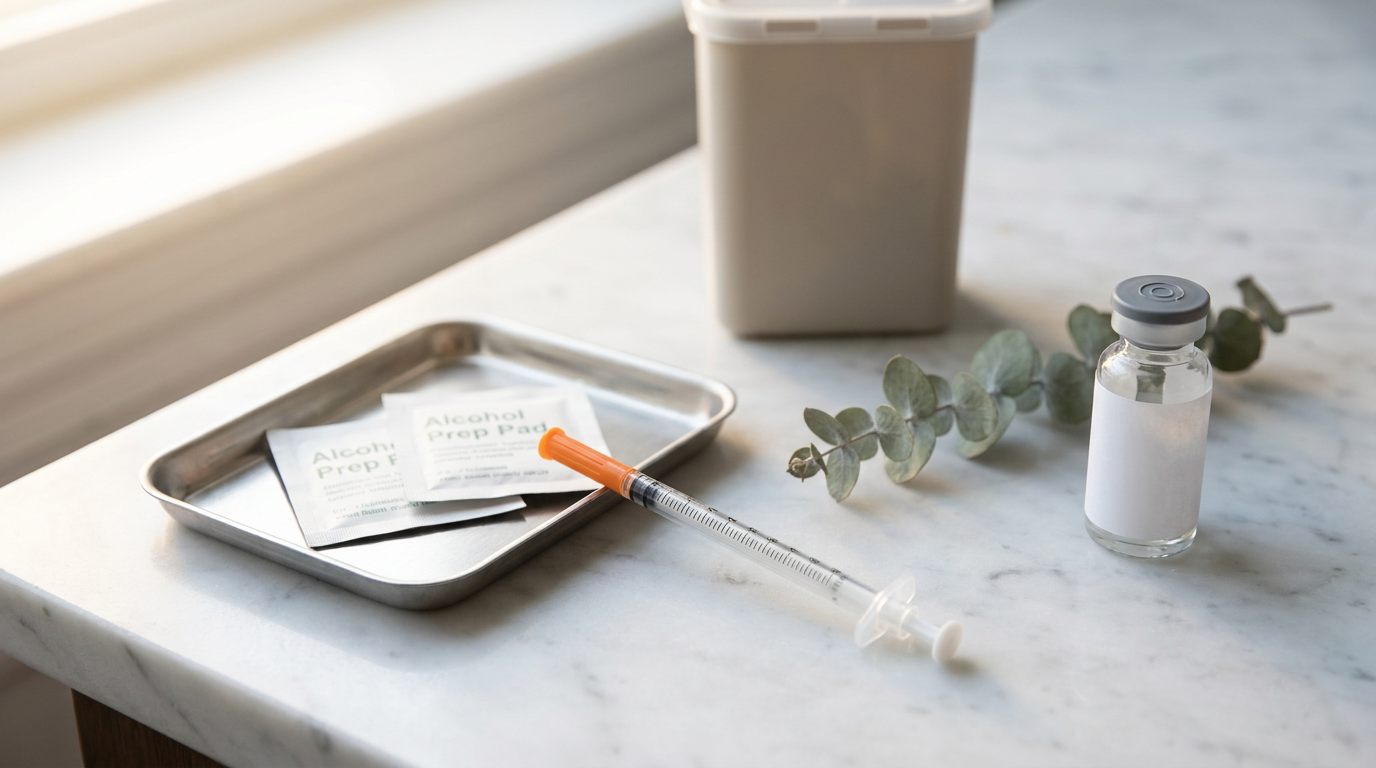
What Every Peptide Researcher Needs to Know About Subcutaneous Injection
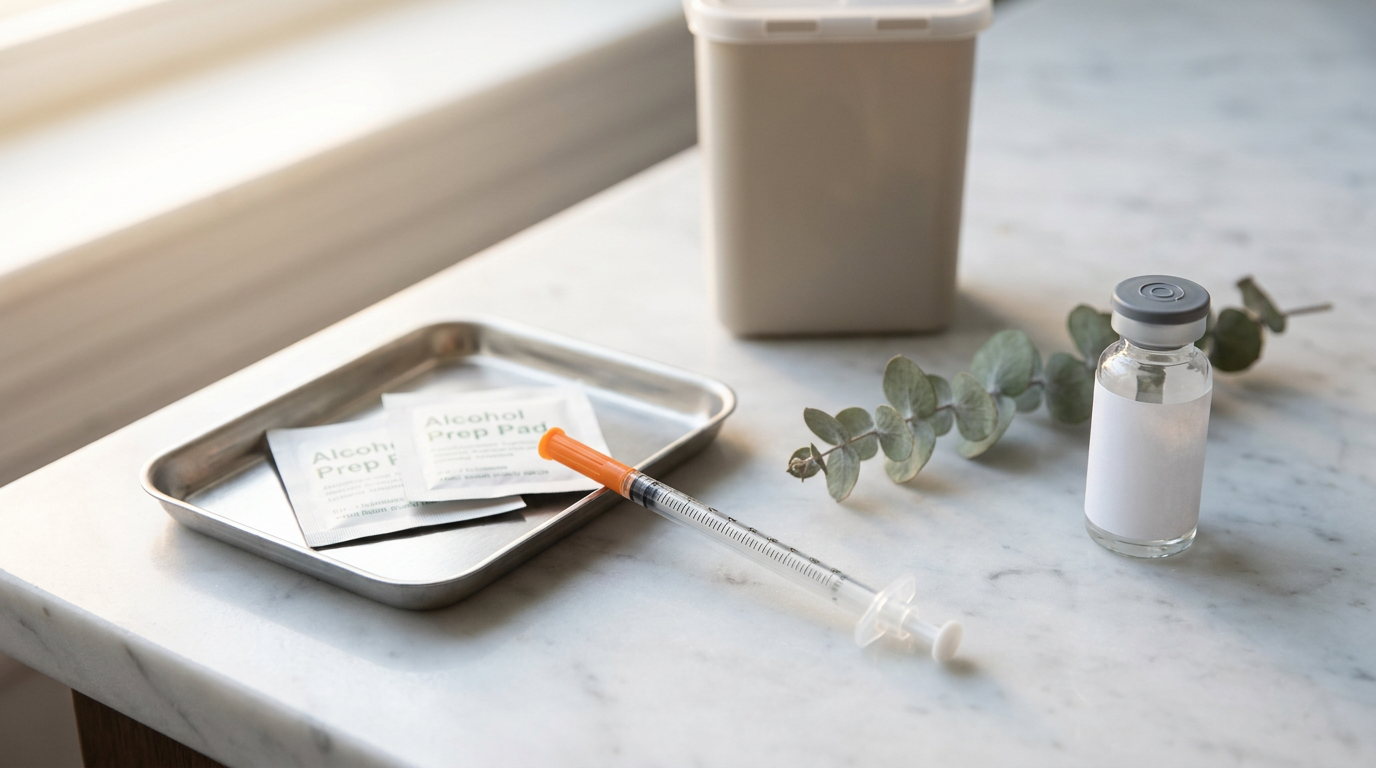
A subcutaneous injection delivers a compound into the fatty layer of tissue that sits just beneath the skin and above the muscle — the slow-absorbing depot that most research peptides are formulated to use. Clean subcutaneous injection technique is not a minor detail. It is the difference between a reproducible protocol and one quietly confounded by infection risk, inconsistent absorption, and avoidable tissue damage.
This reference is for anyone administering subcutaneous (SC, SQ, or "sub-Q") preparations who wants the technique done correctly from the first draw to final disposal. It covers site selection and rotation, needle gauge and length, the pinch-versus-no-pinch decision, and the sharps-handling steps that close the loop safely.
- Site selection — abdomen, thigh, or upper-arm fatty tissue
- Site rotation — moving each injection at least one inch
- Needle selection — gauge and length matched to depth
- Angle and pinch — 90° vs 45°, skinfold or flat
- Aseptic preparation — single-use, clean field, alcohol prep
- Sharps disposal — FDA-cleared container, never loose
- Absorption consistency — depth and site shape the uptake rate
- Infection risk — every skin puncture is a potential entry point
- Lipohypertrophy — repeated same-site injection thickens tissue
- Pain and bruising — needle length and angle influence both
- Disposal rules — sharps handling is legally governed
- Documentation — recording sites supports disciplined rotation
By the end of this reference you will be able to choose a site, select an appropriate needle, decide whether to pinch, and dispose of sharps in a way that protects both the integrity of your research and the people around you.
Greenstone Peptides supplies research-grade compounds sourced from USA-origin raw materials, compounded to USP 797 sterile standards, and third-party tested for purity and identity — so readers can evaluate the research with confidence.
The Core Elements of Subcutaneous Injection Technique
The subcutaneous route has been refined over decades of insulin and biologic delivery, and the 2025 FITTER Forward expert recommendations reaffirmed a principle that now anchors nearly all SC practice: shorter needles, placed in well-rotated healthy tissue, deliver reliably while reducing pain and complications. The same fundamentals — a clean field, correct depth, and disciplined rotation — apply whether the compound is insulin, a monoclonal antibody, or a research peptide.
Guidance from the U.S. Centers for Disease Control and Prevention frames the single most important rule in plain terms: one needle and one syringe, one time, for one person. Reuse is a documented vector for bloodborne infection, which is why aseptic technique and single-use supplies are non-negotiable rather than optional refinements.

Choosing and Rotating Injection Sites
There are three standard subcutaneous injection sites: the abdomen, the outer thigh, and the back or side of the upper arm. Each offers a reliable fatty layer when handled correctly, and each has boundaries worth respecting so the needle reaches fat rather than muscle or dermis.
- Abdomen — below the ribs and above the hip bones, staying at least two inches from the navel; the most accessible and consistently absorbing site (MedlinePlus, NIH/NLM).
- Outer thigh — the front and outer surface, roughly a hand's width below the hip and above the knee.
- Upper arm — the back or side fatty area, at least three inches below the shoulder and three inches above the elbow.
- Rotation rule — move each injection at least one inch from the last, and use only sites free of redness, swelling, scarring, or bruising.
Systematic rotation is what prevents lipohypertrophy — the firm, rubbery tissue thickening that develops when the same spot absorbs repeated injections, and which in turn makes absorption erratic and unpredictable. A simple grid or calendar approach keeps sites spread out and recovering between uses.
Needle Gauge, Length, and the Mechanics of Depth
Needle choice determines whether the compound actually lands in subcutaneous tissue rather than skin or muscle. Two numbers matter: gauge, the bore width, where a higher number means a thinner needle; and length, which sets how deep the tip travels.

The most consequential shift in injection guidance over the past decade is the move to shorter needles. The landmark recommendations published in Mayo Clinic Proceedings concluded that the shortest available needles — a 4 mm pen needle or a 6 mm syringe needle — are appropriate for all adults regardless of age, sex, or body size, because they deliver comparable results with less pain and a lower risk of accidental intramuscular injection.
A thinner, shorter needle is generally more comfortable, but bore width also affects how easily a viscous reconstituted solution draws and injects. For most subcutaneous peptide work, a fine-gauge short needle around 29-31G balances comfort against practical handling. Good drawing technique starts upstream, too — our reference on how to reconstitute peptides walks through the steps that precede the injection itself.
How to Choose the Right Needle and Angle for Your Injection
This is the highest-friction part of subcutaneous technique, because the "right" answer depends on needle length, body composition, and the site you are using. The table below maps the common needle options to who they suit and how to position them.
| Needle Option | Length | Typical Gauge | Best Suited For | Angle & Pinch |
|---|---|---|---|---|
| Standard insulin syringe fixed-needle syringe |
12.7 mm (1/2") | 28-30G | Legacy/longer-needle setups | 45° with pinch |
| Short syringe needle vial-draw syringe |
6 mm | 30-31G | Most adults drawing from a vial | 90°, pinch optional |
| Standard pen needle pen device |
8 mm | 31G | Older pen-device guidance | 45-90° with pinch |
| Short pen needle current best-practice default |
4 mm | 32-33G | All adults, regardless of BMI | 90°, usually no pinch |
If you optimize a single variable, optimize needle length. A shorter needle is the most reliable lever for staying in the subcutaneous layer: it reduces the chance of reaching muscle, which is the error most likely to change how fast a compound is absorbed and to increase discomfort. With a 4 mm needle, most adults can inject straight in at 90 degrees without a skinfold at all.
Bruising, Pain, and Leakage — Practical Tips
The most common worries with self-administered injections are bruising, stinging, and a small bead of fluid leaking back out. Each has a concrete fix.
- Let the alcohol fully air-dry for about 10-15 seconds before inserting; injecting through wet alcohol is a leading cause of stinging.
- Insert and withdraw the needle at the same angle in one smooth motion to minimize tissue tearing and bruising.
- If you see leakage ("backflow"), wait a slow count of 5-10 seconds after injecting before withdrawing the needle.
- Avoid rubbing the site afterward; apply light pressure with clean gauze instead if needed.
Matching your supplies to the protocol matters as much as the technique — you can review compound options on the Greenstone store to plan sourcing before you begin.
Pinch vs. No-Pinch — Understanding the Difference
A skinfold pinch lifts the subcutaneous layer away from the muscle so a longer needle does not reach it. With longer needles (8 mm and up), a pinch combined with a 45-degree angle is the safer default. With a very short 4 mm needle, the subcutaneous layer is shallow enough that most adults can inject at 90 degrees flat against the skin, no pinch required.
The decision is driven by one priority: keeping the tip in fat. Leaner individuals, thin-tissue sites, and longer needles all push toward pinching; abundant subcutaneous tissue and short needles push toward a flat 90-degree insertion. When in doubt, a gentle pinch with a short needle is rarely wrong.
Subcutaneous Technique for Every Stage of a Protocol

- Someone new to subcutaneous injection — start with the abdomen and a short 4-6 mm needle; the abdominal site is the easiest to reach, pinch, and rotate while building confidence.
- An experienced self-injector — the priority shifts to rotation discipline and watching for early lipohypertrophy, since cumulative same-site use is the main long-run risk.
- A clinical or supervised setting — documentation, sharps protocols, and standardized aseptic preparation take precedence, with technique formalized across multiple administrators.
First-Time vs. Experienced vs. Clinical Approaches
The right level of rigor scales with how often and in what context injections happen.
- First-time: a short needle, a single accessible site, careful alcohol prep, and a sharps container on hand — the minimum to inject safely and build a habit.
- Experienced: a documented rotation map across all three site regions and routine inspection for tissue changes — the meaningful next step for anyone injecting regularly.
- Clinical: standardized protocols, formal aseptic fields, and disposal logging — justified wherever multiple people administer or oversight is required.
Personalization and Protocol Considerations
A clear trend across 2025 and into 2026 is the convergence of injection guidance toward shorter needles and more structured rotation, even outside diabetes care, as more biologics and research peptides move to subcutaneous delivery. That shift makes a few personalization levers worth attention.
- Body composition — leaner tissue favors shorter needles and a pinch; more subcutaneous fat allows flat 90-degree insertion.
- Injection frequency — higher frequency demands a wider, more deliberately tracked rotation map.
- Compound viscosity — thicker reconstituted solutions may warrant a slightly larger bore for smoother handling.
Why Sourcing and Compounding Standards Matter for Injection Safety
Even flawless technique cannot compensate for what is inside the vial. If a compound's purity, sterility, or identity is uncertain, no amount of careful site rotation or needle selection closes that gap. This is the part of the process most readers cannot inspect themselves — and where sourcing and compounding standards do the work.
- USA-sourced raw materials — traceable origin for every active ingredient.
- USP 797 sterile compounding — preparation under validated sterile conditions.
- Third-party testing — HPLC purity, mass-spec identity, and endotoxin screening.
- Cold-chain shipping — temperature control and proper storage at dispatch.
Getting the Most Out of Your Injection Routine
- Inspect every solution before drawing — it should be clear and particle-free; discard anything cloudy or discolored.
- Keep a simple written rotation log; a small grid beats memory for spreading sites at least one inch apart.
- Bring reconstituted compounds to room temperature briefly before injecting to reduce stinging, while respecting storage limits.
- Store and handle compounds per their stability window — see our peptide storage guide to protect integrity between doses.
Frequently Asked Questions About Subcutaneous Injection
How do I know if I'm injecting into the right layer?
If you can comfortably pinch an inch of skin and fatty tissue, that pinch is your subcutaneous layer. With a short 4-6 mm needle inserted at 90 degrees, the tip stays in that fat rather than reaching muscle. Sharp, deep aching during injection can signal the needle has gone too deep — a cue to use a shorter needle or a pinch next time.
What's the correct way to dispose of needles after injecting?
The U.S. FDA recommends placing used needles into an FDA-cleared sharps container immediately after use. Key steps:
- Drop the needle in right away — never recap, bend, or set it down loose.
- Use a puncture-resistant, leak-resistant container with a tight-fitting lid.
- Replace the container when it is about three-quarters full.
- Follow your community's disposal guidelines — never trash, flush, or recycle loose sharps.
Can I reuse a needle if it still looks clean?
No. A needle and syringe are single-use, one-person supplies — this is the CDC's foremost injection-safety rule. Reuse dulls the needle (increasing pain and tissue trauma) and introduces contamination risk that visual inspection cannot rule out. Use a fresh sterile needle for every injection, every time.
Conclusion
Subcutaneous injection is a learnable, repeatable skill, not a leap of faith. The core question from the start — how do I do this cleanly and consistently? — comes down to a short list you now hold: pick a healthy site, rotate it, choose a short fine-gauge needle, decide on the pinch based on your tissue, and close the loop with proper sharps disposal. Done well, the technique becomes invisible, and the research speaks for itself.
From here, explore the Greenstone store to plan your compounds, and take the next step toward a routine built on clean technique and verified sourcing.
Greenstone Peptides content is educational and does not constitute medical advice. Peptide therapies should be discussed with a licensed healthcare provider.
Sources
The following sources informed this article. Greenstone Peptides does not endorse any third-party organization; links are provided for research transparency.
- Centers for Disease Control and Prevention. "Safe Injection Practices to Prevent Transmission of Infections to Patients." CDC, 2024. https://www.cdc.gov/injection-safety/hcp/clinical-guidance/index.html
- U.S. National Library of Medicine. "Subcutaneous (SQ) injections." MedlinePlus Medical Encyclopedia, 2024. https://medlineplus.gov/ency/patientinstructions/000430.htm
- Frid AH, Kreugel G, Grassi G, et al. "New Insulin Delivery Recommendations." Mayo Clinic Proceedings, 2016;91(9):1231-1255. https://www.mayoclinicproceedings.org/article/s0025-6196(16)30321-4/fulltext
- FITTER Forward Expert Recommendations. "Advance Insulin Injection Technique and Education." Mayo Clinic Proceedings, 2025. https://www.mayoclinicproceedings.org/article/S0025-6196(25)00030-8/fulltext
- U.S. Food and Drug Administration. "Safely Using Sharps (Needles and Syringes) at Home, at Work and on Travel." FDA, 2024. https://www.fda.gov/medical-devices/consumer-products/safely-using-sharps-needles-and-syringes-home-work-and-travel
- U.S. Food and Drug Administration. "Best Way to Get Rid of Used Needles and Other Sharps." FDA, 2024. https://www.fda.gov/medical-devices/safely-using-sharps-needles-and-syringes-home-work-and-travel/best-way-get-rid-used-needles-and-other-sharps